As a professional in the custom sportswear industry, understanding the global supply chain isn’t just theoretical; it’s essential for making informed sourcing decisions. This 2025 guide offers a deep dive into Under Armour’s complex global manufacturing strategy, spanning 18 countries. We analyze their key production hubs in Asia and beyond, explain what the “Made In” label truly means, and uncover how their distributed model minimizes risk—insights that can help you more effectively evaluate your own supply chain partners.
Where Is Under Armour Made?
In my experience, Under Armour’s supply flow is a great example of global diversification. The company doesn’t rely on one country. Its products are sourced from at least 18 different nations. I believe this distributed manufacturing model is smart. It helps Under Armour manage costs, use regional skills, and lower risks from political or market issues.
Key Manufacturing Hubs: Where Under Armour Products Are Made
For apparel and accessories, I’ve noticed that China, Vietnam, Malaysia, and Jordan are the biggest producers. These four countries make about 68% of Under Armour’s output in these categories. Here is a look at the numbers:
-
China: This country handles 30–35% of global production. It is a major center for both clothing and footwear, with large factories that employ thousands.
-
Vietnam: Produces 20–25% of Under Armour’s products and has a strong focus on footwear. I’ve seen some Vietnamese factories produce up to 15–20 million pairs of shoes every year.
-
Indonesia: This country specializes in footwear. It supplies about 15–20% of Under Armour’s shoes.
-
Jordan and Malaysia: I see these as important for premium apparel and technical gear. Their location also helps them serve key markets.
-
Other countries like Cambodia, Mexico, Honduras, and the USA also play a part. Each handles a portion of production. They often produce team uniforms or basic sports apparel.
|
Country |
% Global Output |
Key Roles |
|---|---|---|
|
China |
30–35% |
Apparel, footwear, accessories |
|
Vietnam |
20–25% |
Footwear, advanced manufacturing |
|
Indonesia |
15–20% (footwear) |
Shoes, skilled labor |
|
Jordan |
~5–7% |
EMEA market, premium segment |
|
Malaysia |
3–5% |
Technical gear, fabrics |
|
Cambodia |
3–5% |
Basic apparel, accessories |
|
Mexico |
3–5% |
North American supply |
|
Honduras |
2–3% |
Team uniforms, essentials |
Shifting Partnerships for Maximum Flexibility
Ten main manufacturers produce the majority of products. They handle 57% of all Under Armour apparel and accessories. I find it smart that Under Armour doesn’t lock into long-term deals with any single partner. This flexible method lets the company switch suppliers when needed. I suggest this approach because it improves their response to shifts in cost, demand, or rules.
How Country of Origin Labels Work
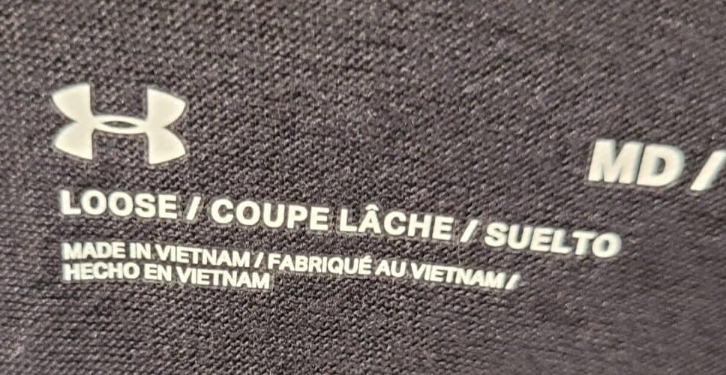
You shouldn’t be fooled by the “Made In” tag. It shows where the product was assembled, not where the materials began. For instance, a shirt labeled “Made in Vietnam” might use fabric from China and trims from Malaysia. In the U.S., labels show where the last major manufacturing step occurred. This makes American-made labels uncommon for the brand. From my observation, Under Armour produces less than 2,000 units (like $120 leggings or $50 bras) in the U.S. each year.
Typical apparel label: “Made in China” or “Made in Vietnam”
Accessories: “Made in Malaysia” or “Made in Cambodia”
Footwear: “Made in Vietnam” or “Made in Indonesia”
Related Reading:Why Are Most Bathrobes Made With French Terry Fabric?
A Look at Under Armour’s Top Manufacturing Countries
China: Under Armour’s Manufacturing Powerhouse
From my perspective, China is the core of Under Armour’s global production network. For 2025, about 30–35% of all Under Armour products are made there. I used to think of small workshops, but that’s not the case. In Guangzhou, Under Armour uses a huge 500,000-square-foot facility. Over 3,000 skilled workers are employed there. It’s not just about the size of the operation; it’s about what they make. The Guangzhou factory produces large volumes of clothing, shoes, and accessories. In my view, the Fujian Province facility is special. This is where they create high-tech fabrics using advanced machines and very strict quality control.
So Why Does Under Armour Choose These Chinese Locations?
China offers a great balance. They can make products in large numbers cheaply, but the quality stays high. China has thousands of experienced workers. This means the products are made consistently, even in large numbers. The factories use new equipment and have great logistics. This lets them change production schedules quickly. For a brand like Under Armour, I think speed is essential to keep up with new trends.
I’ve noticed a larger trend, too. China is still the main hub, but Under Armour is spreading its manufacturing out. They now focus more on Vietnam, Indonesia, and other countries in Asia. I see this as more than just good production planning. It’s how they manage costs and reduce risks across the globe.
Based on my analysis, China isn’t just a place to make things. It’s a key part of their strategy. The modern factories, talented workers, and good prices make China the foundation of Under Armour’s manufacturing. I believe this will continue for 2025 and after. From my experience, if your Under Armour gear says “Made in China,” you have a product from the core of their production system. I suggest appreciating that it comes from a system designed to be strong, affordable, and fast.

Related Reading:A Step-by-Step Guide on How to Start Custom Sportswear Brand From Scratch (Easy&Actionable)
Who Makes Under Armour Products?
Under Armour’s Manufacturing Partners and Global Production Model
Under Armour’s products are made by many partners in specialized factories across the globe. The company directs the process. They control the fabric choices, designs, and new product ideas. At the same time, they use the skills and production power of their partners. I believe this model ensures you always get Under Armour’s signature quality, regardless of where the item was made.
-
China is a major hub. The Guangzhou facility alone is over 500,000 square feet and has more than 3,000 skilled workers. From what I see, the Fujian factory is all about high-tech fabrics and strict quality control.
-
Vietnam offers great size and skill. The Ho Chi Minh City site is huge at 800,000 square feet. It makes 15–20 million pairs of shoes a year with impressive speed and quality.
-
Indonesia, Malaysia, and Jordan are reliable partners for top-quality performance gear. They help Under Armour stay flexible in markets around the world.
Licensed Manufacturing for Team Uniforms
I find their team sports business quite interesting. Since January 2026, BSN SPORTS has been the official maker and seller of their team uniforms. They provide over 1,400 sales experts and design tools. Momentec Brands is also a key partner. It produces custom, high-quality sublimated uniforms with a direct license.
Both of these partners work under close supervision from Under Armour’s teams. This keeps the design and material quality high. It also makes sure every uniform lives up to the brand’s promise. This is a practical strategy. In 2025, Under Armour became the uniform supplier for the Canadian Hockey League, which expanded its own manufacturing work.
The Bottom Line
Under Armour products are created by a skilled group of manufacturers. Most are in Asia, chosen for their efficiency and expertise. Select partners in the Americas handle team sports and special orders.
This flexible network is vital. It is how they deliver the new products and consistent quality that fans have come to expect. From my perspective, this strategy allows the brand to stay ahead of trends and meet customer needs, one partnership at a time.
How Under Armour Chooses Manufacturing Sites
Cost is a Top Priority
Under Armour picks countries like China and Vietnam. These places offer low labor costs and deep manufacturing experience. I see that China handles about 30–35% of their production. Vietnam makes another 20–25%. In my opinion, these regions have affordable labor, solid tech support, and the ability to produce on a huge scale.
Skilled Workers and Technical Skills
For high-tech fabrics and sportswear, I believe Under Armour needs skilled teams in advanced factories. For example, their large facility in Guangzhou, China, has over 3,000 workers and focuses on new ideas. Their famous sites in Ho Chi Minh City, Vietnam, produce 15–20 million pairs of shoes each year.
Technology for High Volume Production
I think the main question for them is: can a factory make things fast and in large numbers? They choose Vietnam’s huge factories and Indonesia’s productive plants for this reason. These locations can make millions of quality products with speed and consistency.
Being Close to Top Markets
Under Armour avoids shipping problems by making products close to its customers. That’s a smart move in my book. Their factories in Jordan supply Europe/EMEA with 5–7% of products. The ones in Mexico make 3–5% for North America. This cuts delivery times and lets them adapt fast to changing market needs.
Spreading Out for Flexibility
I know that supply chain risks are always present. So, I like that Under Armour does not put all its production in one area. They use factories in many countries, including Indonesia, the Philippines, Cambodia, Malaysia, Mexico, and Honduras. This strategy allows them to adjust if tariffs, politics, or other surprises happen.
Conclusion
Looking at Under Armour’s global manufacturing network, I’m impressed by how they’ve built something truly resilient. This isn’t just about making products cheaper – it’s about creating a system that can adapt and thrive no matter what challenges come up. From my perspective, their strategy of spreading production across 18+ countries while maintaining strict quality standards shows real business wisdom. I believe this approach will keep serving them well as the world becomes more unpredictable and interconnected.
Under Armour’s global footprint is impressive, but your business needs a supplier that provides clear, consistent processes without complexities.
Berunwear offers end-to-end custom manufacturing services and complete supply chain transparency. Our dedicated factory specializes in producing performance-focused team uniforms, and professional sportswear.